FNV providing occupational health and safety training in Suriname
Train-the-trainer course
Suriname is about to adopt a new Working Conditions Act (Arbowet) based on the Act in place in the Netherlands. And since the FNV has extensive knowledge regarding health and safety at work, this is even more reason to support trade union colleagues in Suriname. FNV active trade unionist and health and safety specialist Wim Dekkers has already completed two train-the-trainer course sessions with a group of Surinamese union members.

Photo: iStock
The ties between the FNV and the Suriname trade union training institution (Surinaamse Vakbondsscholingsinstituut, abbreviated to SIVIS) go back 55 years, says Wim Dekkers, a retired employee of Chemelot (a chemicals complex in the Dutch province of Limburg). Although these connections ended up on the backburner for a period after Suriname became independent, they were never completely lost.
An occupational accident every 24 hours
In 2019, the FNV received a project request from the SIVIS to train Surinamese workers with regard to knowledge and skills relating to the newly introduced Arbowet. Not a luxury, according to Wim, since an occupational accident occurs every 24 hours in Suriname, often with fatal results. ‘I therefore did not need to think long before taking on this project,’ Wim says. ‘Suriname is going through a tough time, and therefore the trade unions welcome any help. They are aware of the issue but they need actual policy.’ And that is on its way now with the imminent new Working Conditions Act. Although the corona pandemic caused some delays, the first train-the-trainer course session was finally launched in the autumn of 2023. It came about with the support of the FNV and its International Solidarity Working Group for Global Citizens (Werkgroep Internationale Solidariteit-Wereldburgers, abbreviated to WIS), and was financed by the FNV Solidarity Fund.
Working visits to companies
It made sense to ask Wim to do the training. After all, he had already gained a lot of experience with similar courses in Belarus, Colombia, and Türkiye. He had also previously designed a handbook with a kind of ‘toolbox’, addressing all aspects of health and safety in the workplace. ‘In November 2023, I gave the first six-day training course in Paramaribo,’ Wim explains. ‘But we soon realised that six days in a row was too intense. Every day, from 9 a.m. until 3 p.m., the 37 participants were bombarded with information. That was too much to absorb all at once. We now include rest days, during which we visit various companies. One training session now takes about fourteen days in total.’
Participate to gain extra knowledge
One of the participants is Roy Caupain, who works with Suriname’s state oil company, and is president of the company-based trade union (Staatsolie Werknemers Organisatie Suriname, abbreviated to SWOS). The SIVIS asked him to join the course. ‘I am committed to health and safety within the company, so it was logical for me to undertake this training. During the course, my goal is to gain extra knowledge that I can apply within the company. For example, we are busy setting up a committee on flexible work, so as to increase productivity and keep people healthy. I can immediately use the knowledge I gain during the course.’
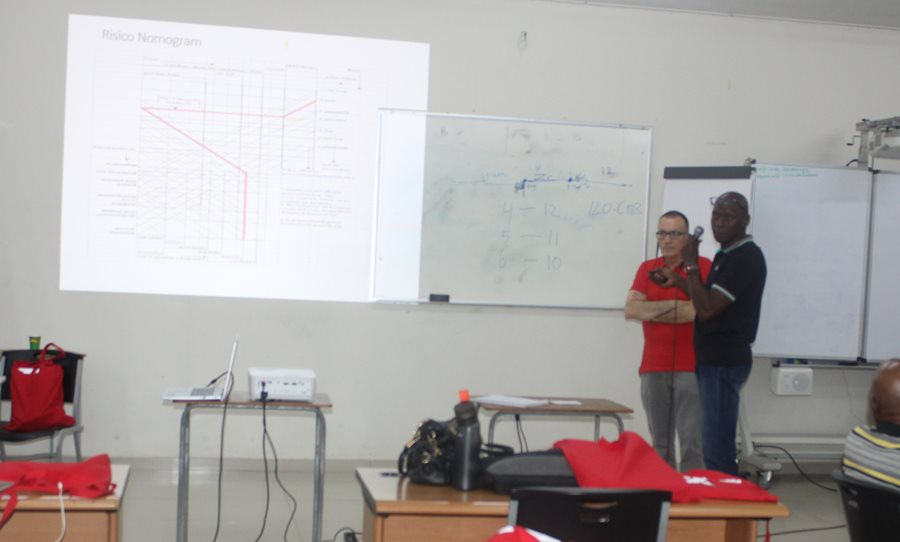
Wim Dekkers en Roy Caupain
Catching up because of the new Act
Roy is enthusiastic about the content. ‘The course is going very well. Wim has a lot of experience and we rely on and benefit from that. Some of the material is new, such as working safely at great heights. In some companies, a committee needs to be set up to conduct a risk assessment beforehand. That was not required under the old law, so we need to catch up in this respect.’
Course participants need to know enough to contribute to policies
Suriname’s culture and work situations are different from those in the Netherlands, says Wim. ‘I try to provide subject matter within this context, which is very rewarding. The participants have been selected by the SIVIS to attend the four sessions, and I constantly choose new topics that are submitted by the participants themselves. The central focus is on what they need. It is important that they gain enough knowledge to start contributing to policy. It is a growth process, just like it was in the Netherlands.’

Much group work
Listening more carefully as a result of training
Participants are given union leave to attend training sessions. ‘Our trade union mostly deals with wages and employment conditions, but safety has now been added,’ says Roy. ‘If permitted, I will also start offering in-company training next year. This training is also useful for collective bargaining. We recently discussed the wearing of safety goggles. I pointed out that it was the employer’s responsibility and was able to demonstrate this on the basis of regulations. I noted that people started to listen more carefully to me, and I was proven right.’
Company visit to the state oil company
The company visits made during the training course are very diverse. Roy’s state oil company was one of them. ‘We saw a clean and well-run operation,’ says Wim, ‘And I was really impressed. We were also invited by a granman, a tribal chief whom we had already met, to visit the interior of the country again on our next visit. We also went to look at a coastal area affected by forest fires - partly in Paramaribo, and the districts of Coronie, and Nickerie. Much of the swamp and marshland that had dried up had caught fire, and the resources to control such events are not available. You can see how this has a direct effect on people, their working conditions, and their environment.’
Support provided by the Handbook on the Working Conditions Act and relevant regulations
Course participants are immersed in the laws and regulations regarding the Working Conditions Act. Wim calls it ‘an anthology of everything governed by health and safety legislation.’ Roy says, ‘It is not easy to remember everything. But I already often apply things within the company, so the rest is just about brushing up your knowledge. I find it interesting because I am dealing with it a lot. Also, there’s Wim’s handbook for support.’ Wim emphasises that the handbook is a loose-leaf system that can be customised. ‘Once the new Working Conditions Act is passed and the legislative texts established, the pages can be adapted if needed.’
Course supported even by legislators
The third training session will take place in the autumn, with the final session in the spring of 2025. Participants will then receive their certificates, officially becoming trainers who can begin teaching colleagues. ‘The certificate is proof of participation,’ says Wim. ‘Both the SIVIS and the Minister of Social Affairs and Employment considered this to be important.’ As a result, even legislators support the course.’
Passing on of knowledge
The follow-up process, the passing on of the knowledge gained, will be coordinated by the SIVIS. The training institution will take into account the work schedules of trade union colleagues. Training sessions will probably take place after working hours or during the evening. ‘The training can be customised,’ says Wim. ‘That is important because sectors like childcare or hospitality have different safety requirements compared to an oil company. The course can adapt well to that.’
Interview: Astrid van Unen
May 2024